Apple has its sights comfortably set on the high-end Android competition with headline features like its one-of-a-kind Dynamic Island, new always-on display functionality, iPhone's first 48Mp camera, and high-end A16 Bionic chipset.
The question is whether Apple's most recent product still provides good value for money despite the substantial price increase (at least in the United Kingdom).
Design & build
The iPhone 14 Pro is almost the same as its predecessor, which is not a bad thing. With new Space Black and Deep Purple finish joining the Silver and Gold of last year's range, Apple's industrial, angular design language and combination of a stainless steel frame with glass front and back feel and look premium.
The three-camera cutout on the brushed glass rear looks the same, but the cameras themselves are a little bit thicker than on the 13 Pro, which is not surprising given the upgraded camera options.
The plot and overall structure are comparable. At 71.5 x 147.5 x 7.85 mm and 206 grams, the iPhone 14 Pro is slightly taller and heavier this time around, but it's hard to tell

.The microphone ports, speaker grilles, and Lightning port are all in the same locations, as are the side button, volume controls, and silence switch. Yes, it has been a year since Apple switched to USB-C with the iPad Air and iPad Pro, but there are rumors that this could change next year.
It has IP68 protection, so it should survive a dip in the water. It is also still dust and water resistant.
The absence of a SIM tray is the only significant design modification to the iPhone 14 Pro. Apple has decided to go all-in on e-SIM technology in the United States, where there is no SIM tray on models sold there. However, it is still present on models sold in the UK, Europe, and most other regions. Although it certainly enhances Apple's minimalistic design, it will be interesting to observe how US customers react to the change. Upon setup, they will be required to transfer their phone number to eSIM.
Display & audio
The 6.1-inch Super Retina XDR display on the iPhone 14 Pro is a significant upgrade over the previous model, which had a resolution of 2556 x 1179. In fact, it represents the most significant shift in Apple iconography since the iPhone X. The whole thing boils down to a single significant addition: the Island in Motion The oblong-shaped cutout, which floats millimeters from the top of the display and completely replaces the recognizable Face ID notch, does something that no other smartphone camera cutout currently does; It takes on new form.

Not only does the Dynamic Island cutout change shape, but it also adds functionality based on what's happening on screen, appearing to expand or contract at will. Since the actual cutout does not change, this is only a software and hardware trick, but it is seamless and somewhat magical nonetheless.
If you take a closer look, you'll see that the cut-out actually consists of a cut-out that is both oblong and circular, with black active display pixels in between, creating the appearance of a single cut-out. Apple was able to conceal the depth sensor behind the display to further compress the Face ID technology within.
The end result is a camera cutout that can display a Face ID icon when scanning your face, ongoing timers, AirPods battery indicators, music controls, and more depending on what you're doing and what app you're using. You can also access additional controls by tapping and holding the cutout. This lets you skip a song, answer a call, or cancel a timer without leaving the app. Once you tap it, the app in question appears.

Apple has transformed a traditional source of annoyance into something novel and truly useful.
In addition, it is not the only display upgrade; Also improved is the ProMotion adaptive display technology, which can now dynamically shift from 120 Hz to as little as 1 Hz. That means you can scroll and play games at a smooth 120Hz refresh rate without sacrificing battery life when you're on a static screen, like the Home screen, where refresh rates can drop.
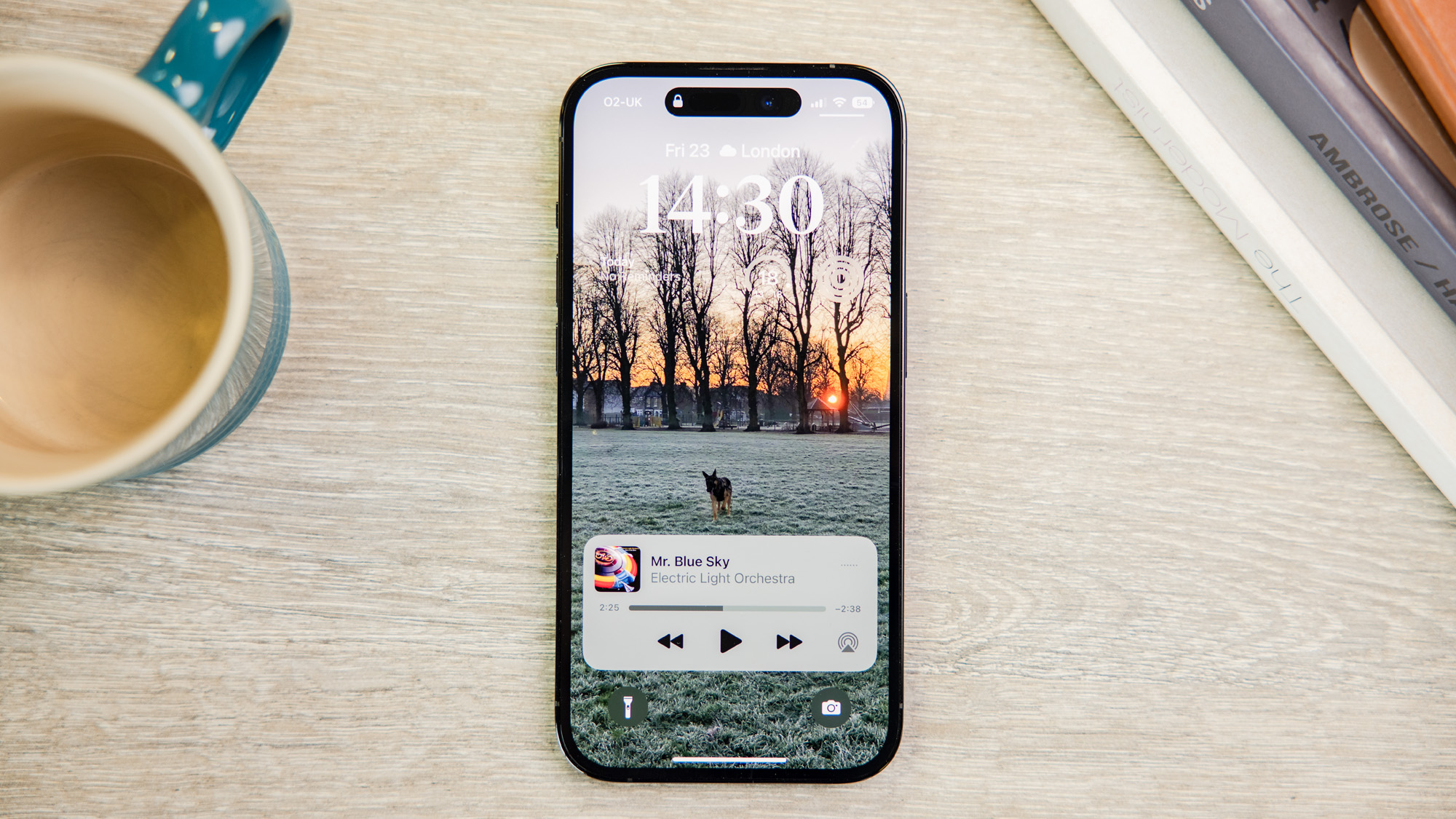
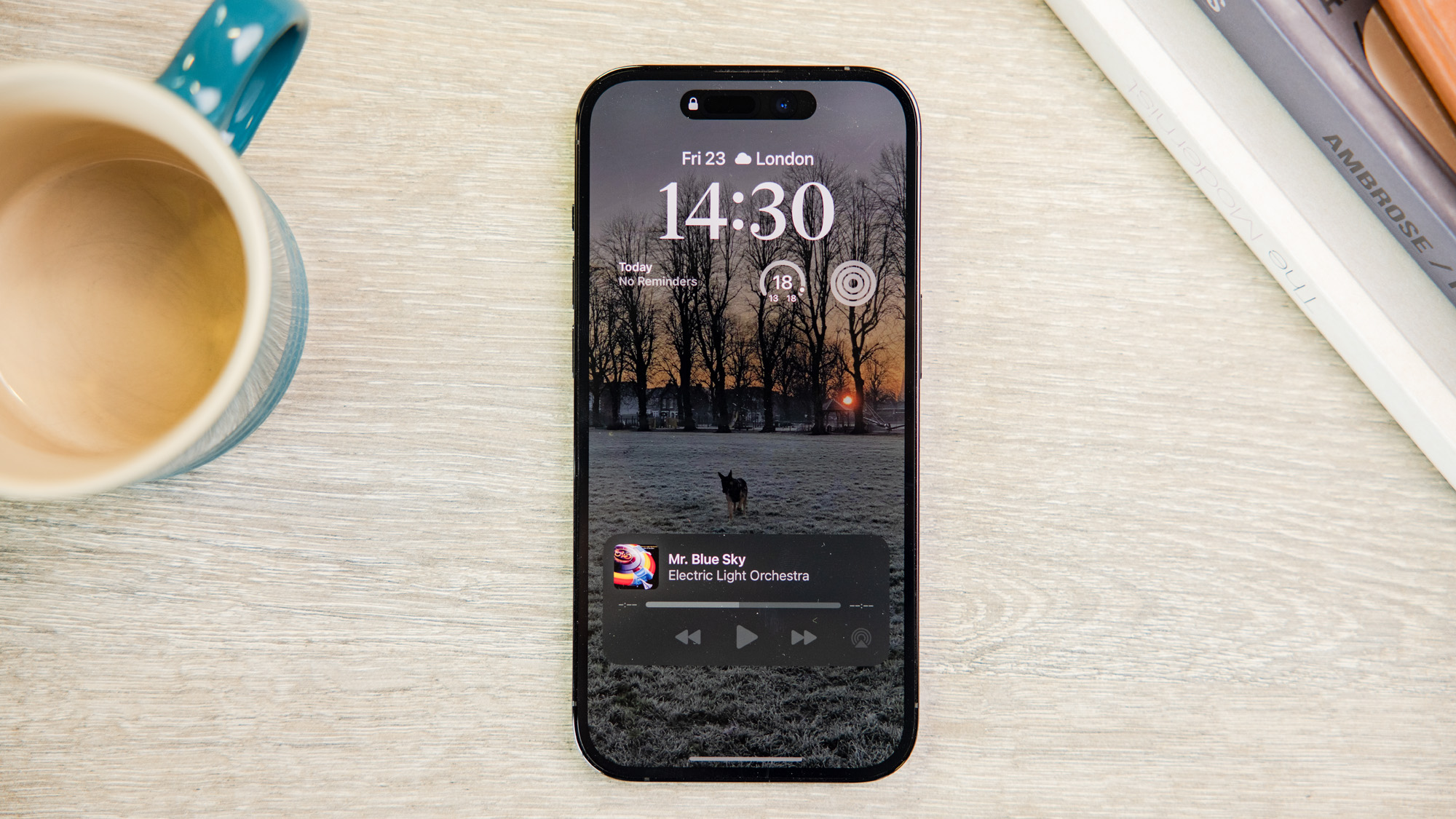
The iPhone now has an always-on display technology for the first time thanks to the addition of the 1Hz refresh rate. Although it took some time to appear, Apple has undoubtedly outdone the majority of its rivals in its implementation.
You get the full iOS Lock Screen experience, not just a black screen with basic information about the time and notifications like most Android alternatives. You can still enjoy your wallpaper, see the current time, and accesses your widgets, notifications, and music controls at a glance despite the fact that the technology automatically activates when the iPhone goes to sleep
I didn't think I needed it, but now that I've used it, it will be hard to use an iPhone without it (though you can turn it off in the settings).
Apple claims that the display has a baseline brightness of 1000 nits. However, when you watch Dolby Vision HDR content, the brightness increases to an impressive 1600 nits, and when you are in direct sunlight, the brightness can reach a blinding 2000 nits. I've never had any trouble seeing the iPhone's display in any lighting, and I doubt that anyone else will either.
When it comes to audio, you can expect the same stereo speaker setup as previous models, as well as Dolby Atmos spatial audio support, which gives shows like Stranger Things more depth. However, if you can, you should still use headphones.
Features & performance
The iPhone 14 Pro and its Pro Max sibling have Apple's most recent and greatest A16 Bionic, in contrast to the iPhone 14 and iPhone 14 Plus, which continue to use the A15 Bionic from last year. Apple claims that its efficiency cores use one-third the power of the unnamed Android competitor and that the 4nm chipset, which is down from the 5nm of the A15 Bionic, offers both a 10% increase in overall performance and improved efficiency.
Even when playing AAA games like Genshin Impact with high graphical settings and scrolling through a media-heavy Twitter feed, that translates to blisteringly fast everyday use without a trace of lag or stutter. It's not just for use every day; The A16 Bionic lets you edit Apple ProRes videos right in the Photos app. You can crop, add filters, and trim the video in just a few seconds and export it.
However, in everyday use, the iPhone 14 Pro does not appear to be significantly faster than the Samsung Galaxy S22 Ultra.
You can choose from four different storage options, ranging from 128 GB to 1 TB. However, due to the excellent integration with iCloud, it is difficult to recommend the highest-end model to anyone who does not shoot in ProRes and ProRAW.
There is 5G, Bluetooth 5.3, Wi-Fi 6 with 22 MIMO support, and NFC for Apple Pay payments in terms of connectivity. It also has Apple's own U1 Ultra-Wideband chip, which makes it easier to find AirTags with precision.
In addition to the usual connectivity options, the iPhone 14 series is one of the first phones in the world to include built-in emergency satellite communications. When in clear sky, they can connect to Globalstar's fleet of low-Earth orbit satellites, allowing you to get in touch with emergency services even when there is no cell signal.
The on-screen assistant asks you questions that will assist in communicating your status, but you are unable to speak directly with EMS responders. Apple's own relay station is connected to satellites that receive this information, and Apple contacts EMS on your behalf. You can also use the technology to update your Find My Location if necessary, and it can send text messages in about 15 seconds.
Although it won't be available to anyone outside of the United States and Canada until November, I haven't been able to test it for myself because it isn't yet active.

Car crash detection is another new feature that lets the iPhone know when you're in a car accident and, if necessary, call first responders on your behalf. It is also available on the Apple Watch Series 8, and the two devices work together to confirm that a crash has occurred, providing travelers in rural areas with additional peace of mind.
Cameras & photography
All three of the iPhone 14 Pro's rear cameras have been upgraded, despite the fact that the rear-facing camera arrangement may not appear to be significantly different at first glance.
The main camera, which has a 48Mp sensor for the first time in iPhone history, is without a doubt the main draw.

Apple employs a "pixel-binning" technique that combines four pixels into one larger pixel, like Android phones with high-resolution sensors, to enhance low-light performance and detail in a final 12Mp image. As you might expect, these pictures are really good. They have great color accuracy, focus quickly, and great detail. I could even see each hair on a picture of my cat Alan.
You can also choose to take a full-resolution, uncompressed 48Mp RAW image with more data, which gives you the ability to adjust lighting, contrast, and shadows in Lightroom or the Photos app. This is useful because, despite improvements made by Apple's new Photonic Engine image processing technology, the iPhone still has a tendency to reduce shadows in automatically processed images a little too much.
The 48Mp f/1.8 camera excels in nighttime photography, with Apple's 64% larger sensor and 2.44-micron pixel size claiming a 2x improvement in low-light photography.
The iPhone 14 Pro provides a very true-to-life look rather than attempting to artificially brighten the scene, as some (but not all) Android competitors do, and it is able to capture subtle details even in low-light conditions. Even though low-light images look better this time, particularly bright spots still blow out.
Though the ultra-wide lens remains at 12Mp, the larger sensor and f/2.2 aperture allow for improved low-light shots. Apple claims it’s 2x more effective in low-light conditions, though it’s still far from what the main lens can capture. The 120-degree ultra-wide angle is ideal for capturing outdoors landscapes, with Apple’s improved anti-distortion tech stopping subjects near the edge from curving.
The larger 1.4-micron pixels and a new lens also improve macro photography, which while still fairly niche, has the ability to take impressively detailed shots from up to 2cm away.
Though the 12Mp 3x telephoto zoom is still lacklustre compared to the Samsung Galaxy S22 Ultra’s 10x optical zoom, the tight angle is ideal for portrait photography and, like the rest of the range, offers a slight boost in low-light performance – though it’s not quite as detailed as the other lenses.

Apple can also use camera trickery to provide a 2x zoom by cropping into the central 12Mp image using the 48Mp sensor. This gives you four levels of zoom with only three cameras, giving you more versatility.
The iPhone 14 Pro can now shoot at 4K@60 fps in Dolby Vision HDR, up from 30 fps on the previous generation. There is also a new Action Mode that helps reduce camera shake even more, but even in good lighting, the results are often noisier than standard videos.
Battery life
Apple, on the other hand, does not make the same boasts about smartphones' battery life as the majority of manufacturers do. The company makes vague battery life promises tied to video playback rather than revealing the battery capacity in milliampere hours (mAh).
Apple claims that the iPhone 14 Pro can play video for 23 hours on a single charge, up from 22 hours on the iPhone 13 Pro. The single-hour increase suggests that the battery is not any larger than it was last year, and the new adaptive display technology and the 4nm A16 Bionic chipset provide the additional efficiency.
Is it realistic to anticipate receiving 23 hours of video playback from a single charge? In my experience, no. I found that the first few days of using the iPhone 14 Pro lasted only a few hours, which I attributed to the background indexing of data that occurs when a new iPhone is set up or restored.
It got better over the course of the day and was able to keep up with TikTok scrolling, texting, gaming, and occasionally having a phone conversation without losing 10 percent before going to bed, but it was still far from Apple's claimed 23 hours.

My experience indicates that I typically get approximately 10 hours of use per day (split between screen on and screen off) before the battery indicator turns red and irritated, prompting me to search for a charger in haste.
That's fine for most people, and if you use it less frequently, it could probably go two days without needing to be charged. However, if you're a bit of a battery hog like I am, the iPhone 14 Plus or iPhone 14 Pro Max from Apple should meet your battery needs better.
Although there is no official increase in the iPhone 14 Pro's charge speed, unofficial reports indicate that it can support up to 25W. Using a (majorly overpowered) 66W charging brick, I found that the phone could be charged to 29% in 15 minutes, 57% in 30 minutes, and 100% in just over an hour. However, there is no charger included in the box, so you will need to buy one separately. Although it falls far short of Android's fast-charging capabilities, its average battery life makes this arguably not much of a problem.
In addition, there is faster 15W MagSafe charging and 7.5W Qi wireless charging, but there is no indication of reverse wireless charging for the iPhone.
Software & updates
iOS 16 is available on almost every iPhone since the iPhone 8 and the iPhone 14 Pro.
While the Android rivals are catching up with OS upgrade promises for multiple years, no one comes close to Apple's regimented update system in terms of software support and longevity. All supported iPhones receive the major updates simultaneously, as opposed to months apart like with Android releases, and phones will receive updates for a significantly longer period of time than Android competitors.iOS 16 is available on almost every iPhone since the iPhone 8 and the iPhone 14 Pro.
While the Android rivals are catching up with OS upgrade promises for multiple years, no one comes close to Apple's regimented update system in terms of software support and longevity. All supported iPhones receive the major updates simultaneously, as opposed to months apart like with Android releases, and phones will receive updates for a significantly longer period of time than Android competitors.
Pricing & availability
In the United States, the iPhone 14 Pro starts at $999, the same price as the iPhone 13 Pro from last year. It's a tempting option due to the impressive upgrades.
However, it is a little more difficult to recommend in the United Kingdom, where it costs £1,099, which is the same price as the most expensive iPhone 13 Pro Max from last year but represents a significant increase of £150.
The iPhone 14 Pro is available for purchase from the Apple Store as well as third-party retailers like Best Buy in the United States and Amazon in the United Kingdom if you're tempted. If you're interested, we go into more detail about where to buy the iPhone 14 range, including contract options.
Verdict
With significant improvements over the iPhone 13 Pro, the iPhone 14 Pro is without a doubt the best iPhone you can buy.
The feature that stands out the most is the Dynamic Island, which uses an impressive combination of hardware and software to make what is typically a source of frustration on modern smartphones a part of the core experience. Another nice feature is the always-on display, which lets you access your wallpaper, widgets, and notifications at any time. It will undoubtedly be difficult to return to using an iPhone without it.
The 48Mp rear camera sensor is another good addition to the Pro lineup this year. It not only gives the camera a big advantage in low-light situations, but it also gives you more detail and even a 2x zoom without a 2x telephoto lens. For closer shots, you can use the 3x telephoto, but Android alternatives can zoom even further.
One of the most advanced smartphones on the market is one with satellite connectivity, a premium build, and additional features like the top-of-the-line A16 Bionic. The Pro Max's only advantages are its larger display and longer battery life, which, despite improvements year after year, can still be lacking on the standard 14 Pro.
Specs
147.5 x 71.5 x 7.85mm
206g
6.1in Super Retina XDR display (2556 x 1179)
Dynamic Island
Always-on display
IP68 dust and water resistance
A16 Bionic
Main 48Mp camera, f/1.78, sensor-shift OIS
120-degree 12Mp ultrawide, f/2.2
12Mp 2x telephoto, f/2.8
4K@60fps with Dolby Vision HDR support
12Mp f/1.9 front-facing camera with autofocus
Bluetooth 4.3
Wi-Fi 6 with 2xMIMO
NFC
Satellite connectivity
Car Crash detection
Best Prices TodayiPhone 14 Pro
$999.9
If you want to buy then click the link : https://amzn.to/3GzuFjh




.webp)

Comments
Post a Comment